
Goldman Sachs pulls AI coding tools from traders and bankers
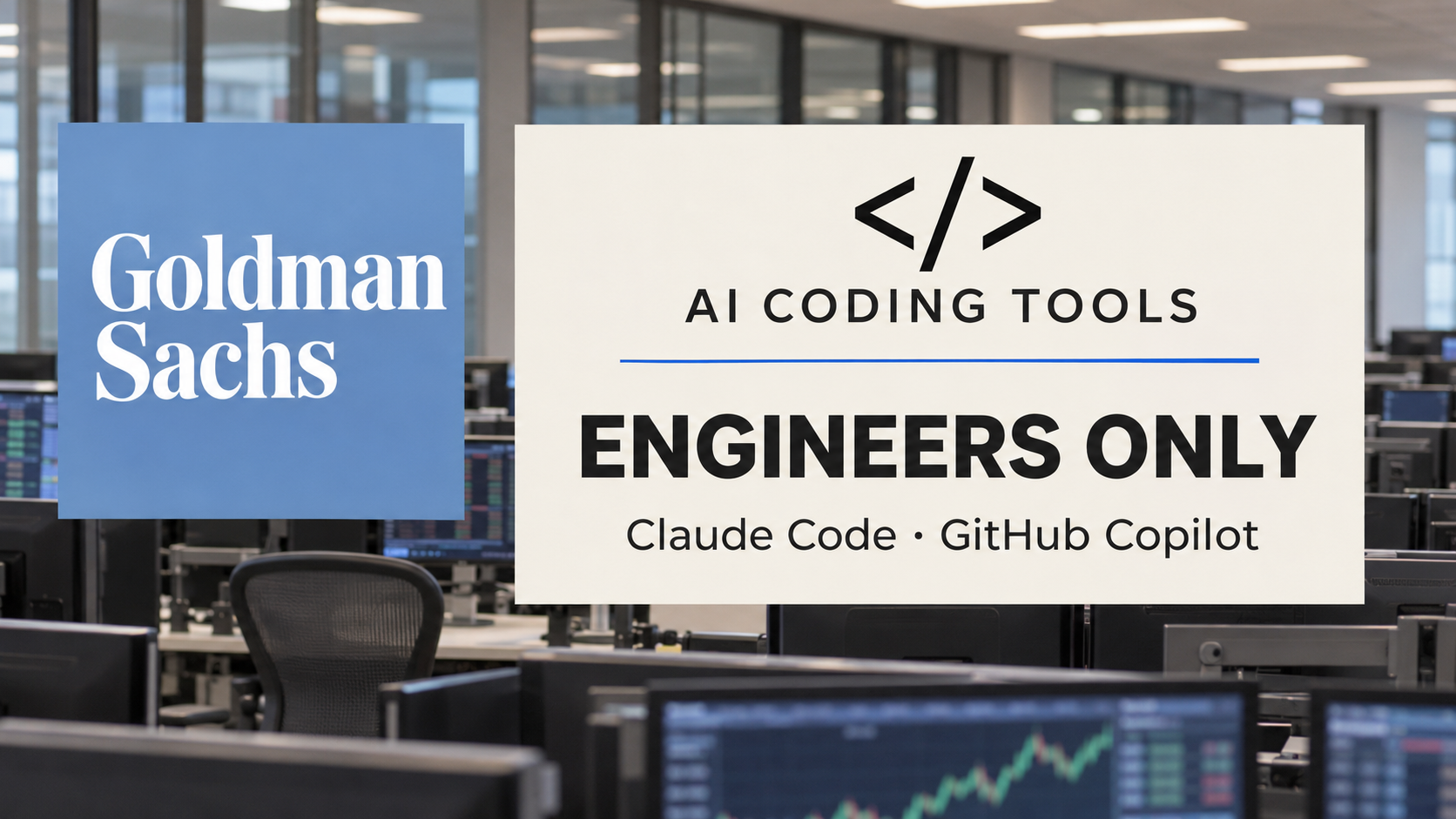
The bank limited Claude Code and GitHub Copilot to its engineers after a review weighed productivity gains against the risks of unreviewed, AI-written code.
 Goldman Sachs
 has cut off most of its bankers and traders from AI coding tools, limiting Anthropic's Claude Code and Microsoft's GitHub Copilot to the bank's own engineers. Bloomberg reported the change on November 2, citing internal guidance Goldman updated in October. Read more: Goldman Sachs pulls AI coding tools from traders and bankers
The bank employs roughly 47,000 people, and about 12,000 of them are engineers. Those engineers also keep access to the tools, along with staff who work across trading, quantitative research and software engineering. Everyone else on the trading floor and in deal teams loses it.
Goldman spokesperson Nick Carcaterra said the bank makes certain AI tools available "to determine the best use cases" across the company, according to PYMNTS. The decision followed a review of factors that included productivity and risk management.


Traders had used the AI coding tools to monitor client trading flows and model market and position moves. They also used the tools to generate written and graphic material for clients.
Related: Big banks lock AI agents out of customers' money
Risk and cost behind the move
State of AI, reporting on Goldman's guidance, noted that these AI coding tools typically run with the same system access as the employee operating them. So unreviewed, agent-written code can reach daily use without the bank's usual testing and deployment controls.
The outlet's own analysis pointed to two more possible factors: compliance concerns over rules that wall off deal bankers from traders, and rising AI costs. Providers bill the tools per token, and spending on them has still climbed at other companies. Goldman did not address either point directly.



The shift reverses an approach Goldman's chief information officer, Marco Argenti, praised just months earlier. In July, Argenti told Bloomberg that nontechnical employees, including traders and bankers, had used AI to build software by describing what they wanted in plain language, rather than writing code themselves.
That approach is often called vibe coding. Those employees then passed the results to the bank's engineers for refinement.
Related: Anthropic's IPO filing reveals an $80 billion paper loss
Other banks draw their own lines
Goldman is not the only bank weighing how far to let AI agents operate inside its walls. JPMorgan Chase CEO Jamie Dimon spoke to analysts on the bank's third-quarter earnings call last month. He said the bank would not let outside AI agents into its systems.
"You don't want rogue agents," he said, warning that unchecked tools create new risks for the bank and its customers.
Bank of America has taken a middle path on AI agents, according to PYMNTS. It limits their access to consumer deposit accounts. The bank is still writing rules on who is liable when an agent authorizes a payment. Citigroup, however, bars third-party agents from logging into accounts or making transactions at all.
Barclays, meanwhile, expects half its developers to be using Claude Code by the end of the year, State of AI reported. That is despite roughly 5,000 job cuts announced weeks earlier, which included some developers.
Anthropic's IPO filing
Anthropic, the company behind Claude Code, filed IPO paperwork with regulators on October 26. Goldman Sachs and Morgan Stanley are named as lead underwriters. The company is also expected to list on the Nasdaq under the ticker ANT before the end of November.
Goldman has not said how long the new limits will stay in place. It also has not said whether they will extend to other AI tools the bank uses.
Its in-house AI assistant, which draws on models from several companies, remains available to all 47,000 employees.
- Goldman Sachs Bars Bankers From Employing Some AI Tools
- Goldman Sachs restricts Claude Code access for traders and bankers
- Goldman Sachs Restricts Traders And Bankers From Using Advanced AI Coding Tools
- Goldman Sachs Bans Traders And Bankers From Using Some AI Tools: Report
- Jamie Dimon warns of 'rogue agents' as JPMorgan weighs AI tools
This story was written by Disruptor Sports journalists working with Claude, a generative AI model made by Anthropic. How our newsroom works.



Comments